We'd like your feedback
Bimonthly Survey
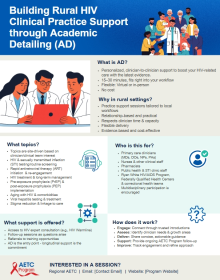
Developed through the collaborative efforts of the National AETC Support Center (NASC) Rural Community of Practice, the Building Rural HIV Clinical Practice Support: Academic Detailing Toolkit provides a practical framework for implementing academic detailing (AD) in rural healthcare settings. The toolkit includes step-by-step implementation guidance, customizable templates, outreach resources, and evaluation tools to help organizations strengthen HIV prevention, treatment, and clinical practice support with collaborating community colleagues. All templates are downloadable and fully editable, serving as adaptable frameworks that organizations can tailor to their unique workflows, resources, and community needs.
Goal: Establish a strong foundation for academic detailing with the rural context.
Actions:
- Map stakeholders: Identify priority partners, including community health centers, RWHAP clinics (medical and dental), local health departments, pharmacies, CBOs, hospitals, correctional settings, substance use treatment programs, PrEP providers, FQHCs, and HIV/STI testing sites. (Include Asset Map template.)
- Define roles: Identify a Rural Provider Detailer. This role may be shared across staff and integrated into existing responsibilities.
- Secure leadership buy-in: Use talking points emphasizing improved patient outcomes, reduced provider burden, and no-cost AETC support.
- Plan delivery format: In-person, virtual, or hybrid based on geography and capacity.
- Ensure technology readiness: Test platforms and prepare both print and digital materials.
- Prepare engagement materials: Customize outreach emails, call scripts, flyers, and scheduling tools.
Tip: Use approachable language (e.g., "practice support session") to avoid concerns about oversight or evaluation.
Goal: Initiate respectful, relationship-centered engagement with clinical teams.
Actions:
- Use trusted instructions: Leverage peer networks, health departments, and community champions.
- Offer flexible scheduling: 15-30 minute sessions aligned with clinical flow; phone or virtual options encouraged.
- Use local data: Share relevant HIV, STI, and prevention data to demonstrate relevance.
- Assess provider needs and growth edge: Prior to or at the start of the session, identify what the provider or team wants to focus on.
Sample Needs Assessment Prompts:
- What HIV-related topics feel most challenging in your practice right now?
- Are there services you would like to offer but don't yet feel comfortable providing?
- What would make this session most useful for you?
Sample Outreach Templates
Initial Outreach Email - Subject Line Options:
- HIV Clinical Training & Practice Support Opportunity
- Brief HIV Care & Prevention Support for Your Clinical Team
- Provider Education & Support: HIV Testing, PrEP, and Care
Email Body:
Dear [Organization Name],
I'm reaching out from [Your Program], which supports rural clinical teams through brief, personalized practice support sessions focused on HIV care and prevention. We are part of the federally funded AIDS Education & Training Center (AETC) Program and provide no-cost training and technical assistance. Sessions are typically 15-30 minutes and scheduled at a time that works best for your team. Topics are tailored to your interests and clinical needs.
Would you be interested in schedule a session?
Warm regards,
[Your Name]
Goal: Provide concise, actionable, and evidence-based guidance tailored to identified needs.
Actions:
- Confirm priority topics based on provider input
- Use one-page fact sheets, case examples, and conversation guides
- Encourage discussion and questions
- Provide clear next steps and resources
- Select relevant topics: HIV testing, PrEP, stigma reduction, aging with HIV, behavioral health, rapid ART initiation
- Use ready-made materials: One-page fact sheets, conversation guides, case examples
- Prescribing PrEP: A Guide for Healthcare Providers | National AETC Support Center (NASC)
- Non-Occupational Post-Exposure Prophylaxis (nPEP) Toolkit | National AETC Support Center (NASC)
- Rapid (Immediate) ART Initiation & Restart: Guide for Clinicians | National AETC Support Center (NASC)
- Share Trusted Resources:
Training & Clinical Decision Support
- National Clinician Consultation Center
aidsetc.org/directory/nccc
Expert clinical consultation for HIV (HIV warmline and Perinatal HIV Hotline), PrEP, PEP, HCV, and substance abuse. - U.S. Department of Health and Human Services HIV Clinical Guidelines
https://clinicalinfo.hiv.gov/en/guidelines
adult/adolescent + pediatric antiretroviral therapy guidelines, perinatal HIV guidelines, adult/adolescent + pediatric opportunistic infection guidelines, caring for people with HIV displaced by disasters guidelines - CDC non-occupational and occupational PEP guidelines
Clinical Guidance for PEP | HIV Nexus | CDC - National HIV Curriculum
hiv.uw.edu
A no cost, up-to-date educational resource for health care professionals to learn about HIV diagnosis, treatment, and prevention - National HIV PrEP Curriculum
hivprep.uw.edu
A no cost, up-to-date educational resource for healthcare professionals to learn how to assess, initiate, and monitor HIV preexposure prophylaxis (PrEP)
Clinical Practice Tools
- AETC HIV Care Tools App
aidsetc.org/app
A free, offline-capable mobile app offering point-of-care tools for clinicians caring for people with or at risk for HIV infection.
Patient & Community Resources
- HRSA Ryan White HIV/AIDS Program
ryanwhite.hrsa.gov
Note: Program availaibility and funding can change. Always verify eligibility and open status before referring patients.
Adapt materials for each clinical care team setting and knowledge level.
Leave-behinds: Provide handouts for clinical care team members.
Ongoing Support & Follow-Up (AETC Program Commitment):
Academic detailing is an entry point – not an endpoint. Providers who expand or adapt HIV-related services are supported through:
- Ongoing regional AETC technical assistance.
- Clinician consultation services (e.g., HIV Warmline)
- Follow-up practice support sessions
- Referrals to self-directed training (National HIV Curriculum, National HIV PrEP Curriculum, National AETC Support Center resources)
This longitudinal support helps providers feel confident sustaining and expanding their scope of practice.
Goal: Monitor engagement, strengthen relationships, and support continuous improvement
Focus initially on process and relationship metrics, such as outreach attempts, sessions completed, topics addressed, and follow-up needs. Patient outcome data may be reconsidered later once trust and data-sharing capacity are established.
Goal: Ensure sustainability and realistic growth
- Prioritize high-impact components during pilot phases
- Standardize core metrics and success stories
- Leverage existing AETC infrastructure
- Share lessons learned through Rural Communities of Practice
- Plan for phased expansion based on capacity and resources
Downloadable AD Toolkit Links:
- One-Page Infographic
- Provider Session Information Sheet
- Provider Outreach Letter
- Scheduling Card
- Asset Map
- Mentoring Assessment
- Provider Detailing Visit Tracking Form